 Superbridge
 native withdrawals follow each rollup's finality rules before assets reach the settlement chain
Superbridge native withdrawals move rollup assets to settlement chains through canonical bridges, with completion governed by each rollup's withdrawal and finality rules. OP Mainnet withdrawals involve initiating, proving, and finalizing, with protocol waits between actions. Arbitrum One requires confirmation of the withdrawal's underlying state before a claim can execute. Superbridge tracks these dependencies, so an elapsed estimate doesn't establish readiness. Available third-party routes offer a different exit path, with their own timing, costs, and availability.
Native settlement and faster delivery carry different constraints
Seven days is the fault challenge period for OP Mainnet's standard native withdrawal flow, with additional time for the surrounding transactions. The full exit includes waiting for a covering proposal, submitting the proof, and executing finalization. Superbridge integrates the canonical contracts and tracks their requirements. A faster third-party route uses a different transfer mechanism, whose quote must cover the selected token, amount, and destination. Its delivery estimate belongs to that route.
Arbitrum One's standard rollup configuration uses a challenge period of 45,818 parent-chain blocks, approximately 6.4 days. Batch posting and assertion timing usually bring the wait until claimable to roughly seven days. A challenged assertion can take longer to confirm. Confirmation then makes the withdrawal eligible for a claim transaction on Ethereum; it doesn't execute that claim. The time until funds arrive therefore includes the later claim's submission and execution.
Other native integrations, including Linea Native Bridge, retain their own finality mechanisms. Arbitrum chains can also use different challenge parameters. A timing estimate for one network can't establish another network's withdrawal schedule.
The current withdrawal state establishes readiness
The settlement chain needs a valid dispute game covering the withdrawal before an OP Stack proof can establish the message's inclusion. Superbridge's Activity data distinguishes actionable transactions from future steps with incomplete prerequisites. A transaction marked
ready
permits submission;
not-ready
means a dependency still blocks that action. An
in-progress
wait remains active until the protocol clears it. An estimated duration describes expected progress, while the current step status identifies whether another transaction can proceed.
OP Stack proving starts a separate maturity clock
Three transactions make up the standard OP Stack exit: initiation on the rollup, followed by proving and finalization on the settlement chain. Initiation records the withdrawal message in the rollup's state. Proving establishes the message's inclusion using a Merkle proof against the output root a dispute game claims. Finalization attempts to execute the withdrawal on the settlement chain once the protocol's eligibility checks pass.
Publication creates an additional timing dependency before proving. A proposal must cover the block containing the withdrawal, so an unrelated proposal doesn't establish readiness. Superbridge estimates dispute game posting and resolution using historical timings. Posting delays and slower resolution can extend the exit beyond that estimate. Those delays affect different parts of the withdrawal: publication gates proving, while resolution affects the game's suitability for finalization.
The proof maturity delay runs from the withdrawal's proving transaction on the settlement chain. Time spent waiting after initiation doesn't age a proof nobody has submitted. A delayed proving transaction therefore shifts the earliest possible finalization. Measuring the whole withdrawal from its initial transaction can obscure this dependency, especially when publication took longer than expected.
Finalization also requires the dispute game to resolve in favor of the proposed output and clear its finality delay. The proof must post-date the game's creation, and the claimed output must remain valid. Meeting the proof's maturity condition alone doesn't satisfy these other checks. The portal rejects finalization when an applicable check fails, so a countdown reaching zero isn't a substitute for an eligible on-chain state.
Re-proving against another dispute game resets the proof timer. That can become necessary if the original game turns out to be invalid, adding another maturity wait to the pending exit.
Network fees accumulate across withdrawal transactions
Each user-submitted withdrawal transaction creates a separate network-fee exposure, so a multi-step canonical exit has no single permanent gas cost. On OP Mainnet, initiation runs on the rollup; proving and finalization run on Ethereum. Their charges can change between submissions. The transaction count and the network executing each action determine which fee estimates matter. A gas balance on the sending rollup doesn't pay for a later Ethereum transaction.
Superbridge doesn't add extra fees for native bridge routes. Normal network charges still apply. The absence of a platform surcharge leaves the costs of proving, finalizing, or claiming with the relevant transactions. A transfer with more required settlement-chain actions can incur more network fees, even when its bridge surcharge is zero. The fee comparison needs the full route, including later actions the initial transaction doesn't complete.
A required ERC-20 approval can add another transaction unless a compatible wallet batches the calls. Existing allowance and the selected quote determine whether that authorization is necessary; it isn't a universal withdrawal charge.
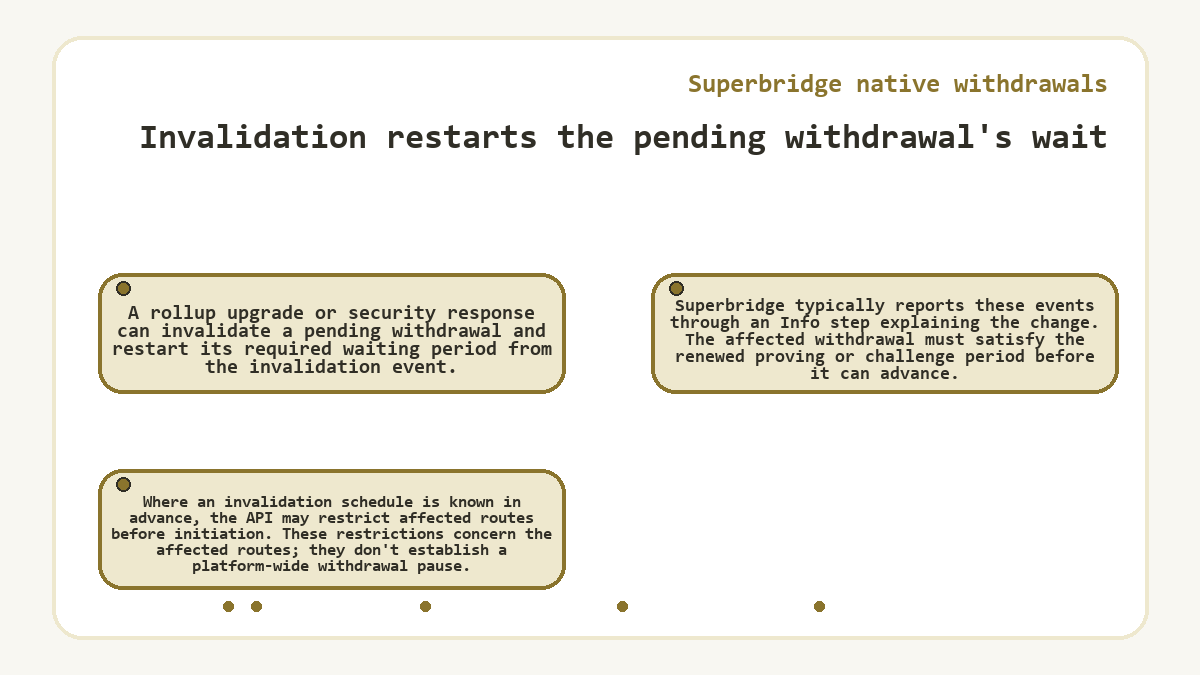
Invalidation restarts the pending withdrawal's wait
A rollup upgrade or security response can invalidate a pending withdrawal and restart its required waiting period from the invalidation event. Superbridge typically reports these events through an Info step explaining the change. The affected withdrawal must satisfy the renewed proving or challenge period before it can advance. Where an invalidation schedule is known in advance, the API may restrict affected routes before initiation. These restrictions concern the affected routes; they don't establish a platform-wide withdrawal pause.
Exit costs guide the route choice before initiation
A quote alone leaves the exit unstarted, allowing a choice between the canonical bridge and an available third-party route before committing funds. Compare both for the same rollup, settlement chain, token, and amount. The canonical path exposes each required network transaction and protocol wait. A faster route has its own quoted costs and availability conditions. If the transfer amount decreases while network charges stay unchanged, those charges consume a larger share of its value.
- Match both route quotes to the same token, amount, sending rollup, and settlement chain.
- Allow for the canonical route's later transactions and waits when assessing its total cost and timing.
- Compare the faster route's fees, expected receive amount, and required steps against the same transfer.
- Keep the initiating transaction unsubmitted while preserving the option to stop or change the route.
- After initiation, compare the expected next action with the current withdrawal status before another submission.
During normal progress, an expected transaction with a matching
ready
status can proceed on its designated chain. If the observed state remains an active wait, the next transaction isn't actionable yet. An invalidation notice changes the next action: allow the renewed wait and follow any revised proving requirement the activity exposes. The old estimate no longer describes that withdrawal's timing. Completion requires the final settlement action and the destination transfer, beyond the initial transaction's confirmation.
A smaller transfer may favor a usable third-party quote when repeated canonical network fees consume more of its value. The native exit follows the rollup's canonical settlement path. A third-party liquidity route delivers funds from a liquidity provider, with provider trust assumptions, fees, and per-asset liquidity limits.
Your questions, answered
Can paying a higher gas fee shorten a native withdrawal's challenge period?
A higher transaction fee doesn't shorten a native withdrawal's mandatory challenge or proof maturity delay. Those waits follow protocol conditions. Gas pricing affects the transaction seeking inclusion, while the withdrawal must separately satisfy its publication, maturity, and finalization requirements. Paying more can't make an ineligible proving or finalization step ready.
When can a late OP Mainnet proof finalize against an already resolved dispute game?
A late proof must complete its own maturity delay even when the dispute game has already resolved in favor of the proposed output. The timer starts with that proving transaction. Finalization also requires the game's finality delay to have cleared and its claimed output to remain valid.
How can I locate a native withdrawal after losing its activity view?
Superbridge's Activity API can find a withdrawal using its initiating transaction hash. The txHash filter identifies that initiating transaction, while the address filter retrieves activity for a wallet. Source and destination chain filters can narrow the results. A later proving or claim transaction hash isn't the initiating hash this filter expects.
Why can an Optimism withdrawal trace contain an internal revert?
Some Optimism withdrawal traces contain expected internal reverts from the Chugsplash Proxy's internal calls. Such a revert alone doesn't establish that the withdrawal failed. Check the overall transaction outcome and actual withdrawal execution state to identify whether finalization succeeded, rather than treating every reverting internal call as a failed exit.
Are mainnet wait periods also applicable to OP Stack withdrawal testnets?
OP Stack test networks can use shorter challenge periods than OP Mainnet. A mainnet duration therefore doesn't establish the waiting period for a testnet withdrawal. The relevant network's configured delays and the selected route's wait steps govern that exit, including the prerequisites for proving and finalization.
Does OP Mainnet permit a second finalization of an already finalized withdrawal?
OP Mainnet's withdrawal portal rejects a second finalization of the same finalized withdrawal. It checks that withdrawal's finalization record to prevent replay. Proving and finalizing are separate operations, so a confirmed proof alone doesn't establish that the portal has already finalized the withdrawal.
Updated -