 Superbridge
 USDC transfers require a route matching the source token and the intended destination form of USDC
Superbridge USDC transfers use bridge and swap quotes to match a source USDC balance with the intended destination token. A compatible path depends on both networks and the exact tokens involved. Circle's Cross-Chain Transfer Protocol version 2 (CCTP V2) moves native USDC through burning and minting. Native bridges and liquidity providers use different mechanisms, and each path must be available for the transfer request. Compare the quoted destination asset, receive amount, fees, and required actions before signing. Quote review leaves the transfer unsubmitted. After initiation, destination delivery remains separate from confirmation of the source transaction. The recipient, destination network, and token identity determine whether the delivered balance matches the transfer you intended.
The source USDC token and destination asset define eligible routes
USDC compatibility is a token-and-network relationship, so the destination asset needs its own selection. Native USDC is Circle-issued, while bridged USDC is issued by a third party and backed by USDC locked in a smart contract on another network. These forms can have different token addresses and transfer support. Ethereum, OP Mainnet, and Arbitrum One have Superbridge network entries; route support remains specific to each USDC form and transfer amount.
The routing response exposes eligibility through a provider's quote or error for the same transfer request. A quote includes the initiating transaction, expected receive amount, fees, and transaction steps. An integration can recognize a quote through its
initiatingTransaction
field. Compare successful quotes for the same request; a provider name in an error result supplies no executable USDC path.
CCTP V2 connects native USDC burns with destination mints
Native USDC delivery
CCTP V2 provides a native USDC transfer mechanism when the selected networks and token contracts support it. CCTP burns native USDC on the source network and mints native USDC on the destination network. Circle's attestation authorizes the destination mint after the required source confirmations. To use this burn-and-mint mechanism, a bridged balance needs a supported conversion into compatible native USDC.
Standard, Fast, and relayed variants
Superbridge's CCTP V2 implementations include Standard and Fast transfers with manual completion and automatic relay, assigning destination submission to the user or a relayer. Fast changes the attestation's finality requirement; it doesn't remove the attestation or destination mint. Some implementation identifiers appear only in activity records, so recognizing an earlier route doesn't establish its availability for new quotes.
Canonical bridges and liquidity providers carry different delivery dependencies
Canonical contract delivery
Native routes use the chain's canonical bridge contracts, with token mapping defining the destination representation. Superbridge integrates OP Stack Native Bridge and Arbitrum Native Bridge, among other protocols. Compare a native path only when it returns a usable quote for the selected USDC token. Its output contract determines whether it delivers the required representation, and a native withdrawal inherits the rollup's settlement requirements. A canonical bridge label doesn't establish Circle-issued native USDC as its output.
Liquidity and solver delivery
Third-party paths can use liquidity providers or solver networks to supply destination tokens. Across and Relay appear in Superbridge's supported provider set. Liquidity-backed routes depend on provider delivery, which adds a trust assumption, and on per-asset liquidity limits. The quote shows their costs. Their output needs the same token-identity check as a canonical route. A shorter delivery estimate concerns timing; the destination token's identity determines which form of USDC arrives.
Which costs belong in a USDC route comparison?
USDC route costs include quoted provider charges and the network fees for the transactions the path requires. The expected receive amount describes the destination token output. Gas may use a separate network token, so the difference between sent and quoted USDC doesn't measure every cost. Compare quotes using the same source network and token, amount, destination network and token, and recipient. Otherwise, an output difference can reflect a different transfer request.
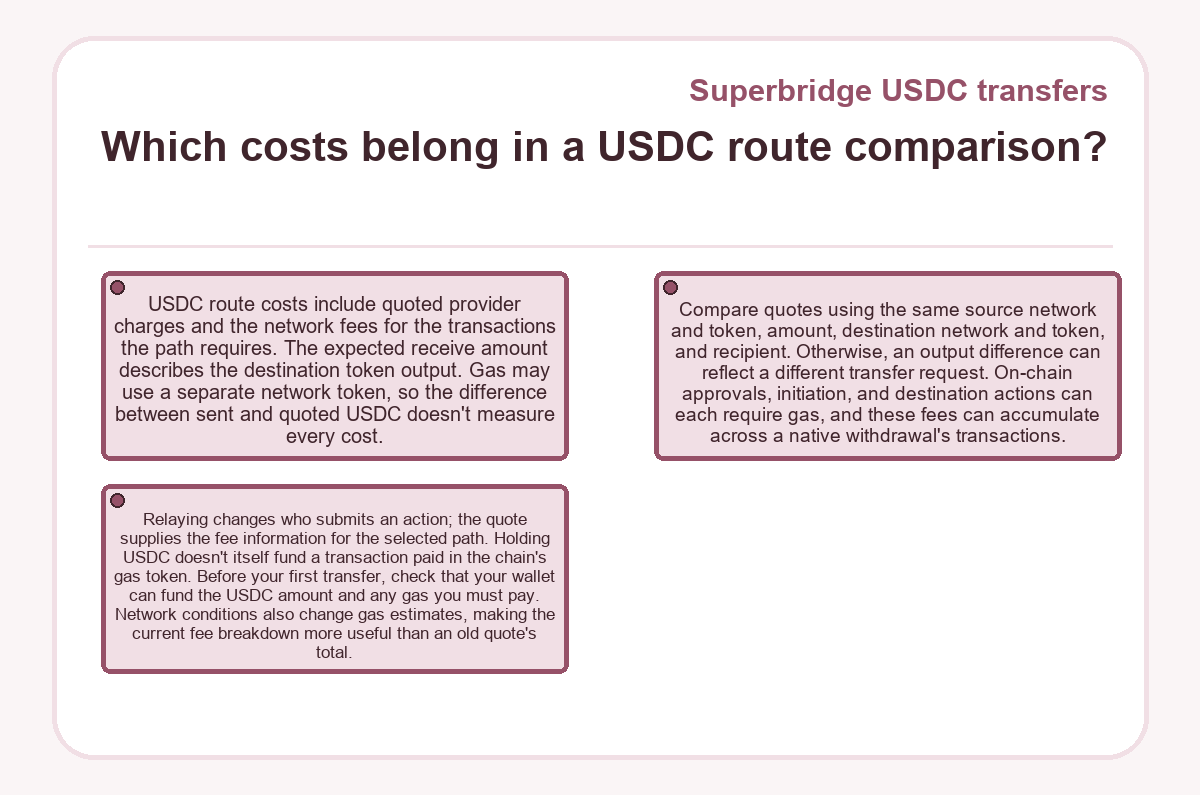
On-chain approvals, initiation, and destination actions can each require gas, and these fees can accumulate across a native withdrawal's transactions. Relaying changes who submits an action; the quote supplies the fee information for the selected path. Holding USDC doesn't itself fund a transaction paid in the chain's gas token. Before your first transfer, check that your wallet can fund the USDC amount and any gas you must pay. Network conditions also change gas estimates, making the current fee breakdown more useful than an old quote's total.
Cross-chain swaps can change the asset USDC becomes
Cross-chain swapping combines bridging with token conversion when the intended destination asset differs from the input. Superbridge routes these combined operations across supported Ethereum Virtual Machine (EVM) and non-EVM chains. A USDC-to-USDC request still needs an output token matching the intended destination form. A quote delivering another asset answers a different request. Combined routing can include protocol waits and later transactions; its quote supplies the expected steps.
EVM approvals and relayed steps divide authorization from submission
The quoted spender
EVM approval grants a specified contract permission to spend USDC, with existing allowance determining whether a new approval is necessary. The approval object's
contractAddress
identifies the spender.
The approval target can differ from the contract called by the initiating transaction.
Review the approval's spender and amount before authorizing it. When using separate transactions for a usable manual CCTP V2 Standard quote, confirm any required EVM approval before signing and submitting its initiating transaction on the source network.
Signed messages and automatic execution
A gasless route uses a signed message for relay instead of direct on-chain submission by the user. An activity step marked
auto
assigns that step's submission to a relayer. These arrangements apply to the selected route or step. They don't make every other required action automatic, and gasless support doesn't establish zero total fees.
| Execution field | Value | Applicable condition | Authorization or submission |
|---|---|---|---|
tokenApproval.amount
|
Minimum required approval amount | EVM quote; approval needed when allowance is insufficient | Wallet authorizes the quoted contract's token spending |
signature
|
User's signed message | Gasless route submission | User signs; relayer handles submission |
transactionType
|
auto
|
Automatically submitted transaction step | Relayer submits that step without user action |
Quote review provides a pause before token authorization
Requesting a quote doesn't grant an allowance or submit the transfer. It establishes the offered token path, estimated output, and required actions before signing. A mismatched destination token is a reason to change the request while the transfer remains unsubmitted. After approval or an initiating transaction, choosing another quote doesn't undo those on-chain actions. Any cancellation, refund, or return depends on the selected protocol and its state. A return transfer requires its own compatible path; availability in one direction doesn't establish availability in reverse.
How can you confirm the intended USDC reached the destination?
Completion requires the selected destination token to reach the intended recipient on the destination network, with the route's required actions finished.
Superbridge activity includes the source and destination tokens, addresses, amounts, and step data. These fields connect the operation to its intended assets and participants. The initiating transaction hash locates the start of the operation. Destination delivery needs its own token-transfer or mint evidence. Match the destination record's network, token address, and recipient to the quote; a receipt on a different network describes a different action.
A quoted receive amount expresses an expected output. The activity payload's
receiveAmount
field alone doesn't establish a confirmed token balance. Its meaning belongs to the associated transaction state and token units. A pending record can contain output information before delivery finishes. The destination transaction and the recipient's balance provide evidence of the token and quantity that actually arrived.
Each transaction status applies to its named action. Source confirmation can leave a required wait or destination transaction unfinished. For a manual CCTP V2 Standard transfer, wait until activity marks the destination mint step ready. Retrieve its transaction data, then sign and submit it on the destination network.
If activity looks complete while the expected balance is absent, compare the destination token address and recipient with the balance you're viewing. A different token representation, address, or network can explain the mismatch. Completion doesn't change the identity of the delivered token or move it to another wallet.
Attestations and rollup finality qualify the delivery estimate
CCTP delivery waits for Circle's attestation and the destination mint transaction. Standard requires source finalization; Fast messages are eligible for attestation at the confirmed level. Delayed attestation retrieval can push minting beyond the estimated arrival time; an elapsed estimate doesn't supply the missing attestation. Destination submission still has to occur through the route's manual or relayed completion arrangement.
For a compatible native withdrawal, the rollup's finality process governs readiness. A fault-proof OP Stack withdrawal requires an applicable dispute game, proof maturity, and the game's resolution and finality conditions. Arbitrum native withdrawal confirmation makes a claim executable; execution releases the funds. These mechanisms explain why native withdrawal timing differs from liquidity delivery. An invalidation can restart a pending withdrawal's wait.
Paused or disabled route results don't provide a usable quote, and amount limits can rule out an otherwise compatible USDC path.
Superbridge USDC transfers FAQ
-
How should an integration encode USDC for its first route request?
- A route request expresses USDC in the selected token's smallest denomination. Convert the human-readable amount using that token's decimal precision before supplying the amount string. On EVM chains, ERC-20 metadata identifies the precision when available. The transfer input remains separate from gas paid in another token.
-
Which chain identifiers can a USDC route request use?
- A USDC route request can identify each network through a chain UID, native chain ID, or shorthand key. Supply one source and one destination identifier; the token addresses separately identify the USDC contracts.
-
When should a USDC quote be refreshed before submission?
- Superbridge's API guidance recommends refreshing route quotes every 30 seconds to reduce stale submissions. This is a refresh recommendation, not an expiry deadline for every provider. Submitting a stale quote can cause an on-chain revert.
-
Can the API restrict a USDC request to selected route implementations?
- The routeIds field restricts results to specified route implementations. Some identifiers appear only in activity records and can't construct quotes. This filter narrows the requested set without overriding amount limits or temporarily unavailable paths; every selected implementation still needs to return a usable quote.
-
Can a USDC recipient differ from the sending wallet?
- The API's separate sender and recipient fields allow a USDC request to name a different destination recipient. The route must support that request. Naming the recipient selects the delivery address; it doesn't establish ownership or control of that address.
-
Where does destination execution obtain gas on a rollup using a custom gas token?
- A compatible route may send a separate gas token alongside USDC to fund destination execution. Its quote can include gasTokenApproval to authorize that token's spending. This permission concerns the gas token, separately from the USDC allowance. It applies when the selected rollup and route require that funding arrangement, rather than to every USDC transfer.
-
Will re-attestation let an expired CCTP V2 Fast Transfer message complete?
- An expired CCTP V2 Fast Transfer burn can receive a renewed attestation while its source-chain burn still exists. Re-attestation refreshes the message's expiration block. The destination mint must use the renewed attestation before that block passes. Renewal doesn't itself mint USDC, so completing destination submission remains a separate requirement.
-
Does resubmitting the same CCTP message mint USDC again?
- CCTP accepts each message nonce only once on the destination domain. Submitting the same message again doesn't authorize a second mint of its USDC. This restriction concerns replay of an existing message; it doesn't prevent a separate transfer from using its own distinct message.
Updated -