 Superbridge
 first transfer and token approval requirements
Superbridge may require an ERC-20 approval before a first transfer when the selected spender lacks sufficient token allowance. An allowance gives a contract permission to spend a particular token on its sending network. Confirming an approval establishes permission; it doesn't finish a bridge or swap. The required action depends on the token, existing allowance, selected route, and wallet capabilities. Match the sending network and token to the quote, then review its spender address and expected transaction steps. A quote review leaves the transfer unsubmitted, providing a reversible stopping point before authorization. Required approvals precede the initiating transaction, although compatible wallets can combine those calls in a batch.
Bottom line: The approval spender can differ from the contract the initiating transaction calls, so both addresses need their own review.
The token and sending network determine the approval type
ERC-20 tokens use spending allowances on networks compatible with the Ethereum Virtual Machine (EVM). A balance records the tokens an address holds, while an allowance records how much a specified contract can spend from that address. Holding the required tokens doesn't automatically authorize the route's spender, and approval doesn't supply a missing token balance. The destination network has a separate role: it identifies where the transfer plans to deliver its output.
A bridge moves value between networks; a cross-chain swap can also change the token received. Review the send token and receive token separately, along with their networks. A quote for a different output token describes a different intended result, even when the sending amount remains unchanged. Token selection therefore affects both the permission needed at the start and the asset expected at the destination.
When does an ERC-20 transfer need approval?
A new approval is needed when the current allowance for the quoted spender falls below the required amount. If the existing allowance already covers that amount, the route doesn't need another token approval for that requirement. An approval field in a quote provides transaction data, so its presence alone doesn't establish that the allowance is insufficient. API integrations need their own allowance checks to determine whether to use it.
For separately submitted EVM transactions, required approvals must confirm before the initiating transaction. Sending an approval to the network doesn't immediately establish usable permission, because submission and confirmation describe different states. The confirmed update must apply to the quoted token and spender. Any other required approvals retain their own dependencies, so completing the input token's approval doesn't settle every possible authorization requirement. The quote's approval objects identify which permissions the selected route may need.
The spender address defines the permission
The approval object's
contractAddress
identifies the spender whose allowance an integration needs to check.
The approval target can differ from the contract the initiating transaction calls.
Those addresses have different jobs within the same route. The spender receives permission to use the specified token; the initiating transaction's target receives the execution call. Review the token, spender, and amount together. A matching spender alone doesn't establish sufficient allowance for the selected token and amount.
Closing the interface after a confirmed approval leaves that permission on-chain. A first session can stop before any approval or transfer submission, while the quote remains only a proposed action. This stopping point avoids changing the allowance. Once an approval confirms, declining a later transfer request leaves the earlier permission update in place.
Connecting a wallet alone doesn't grant an ERC-20 spending allowance.
An approval confirmation before the transfer begins
A confirmed approval can leave permission ready while the bridge transfer remains uninitiated. In this hypothetical EVM case, the quote requires an allowance of 23.7 token units, while the existing allowance for its specified spender is 11.2 units of the same token on the sending network. Assume no zero-reset requirement, custom gas-token approval, or batched execution applies.
The allowance is short by 12.5 token units (23.7 - 11.2). Once the quoted approval succeeds and confirms, it sets the allowance to 23.7 units, replacing the existing 11.2-unit allowance. The wallet's confirmed transaction record is for the approval. At that stopping point, the approval has completed and the initiating transaction remains unsubmitted. The approved amount describes spending permission; it isn't an amount already received on the destination network.
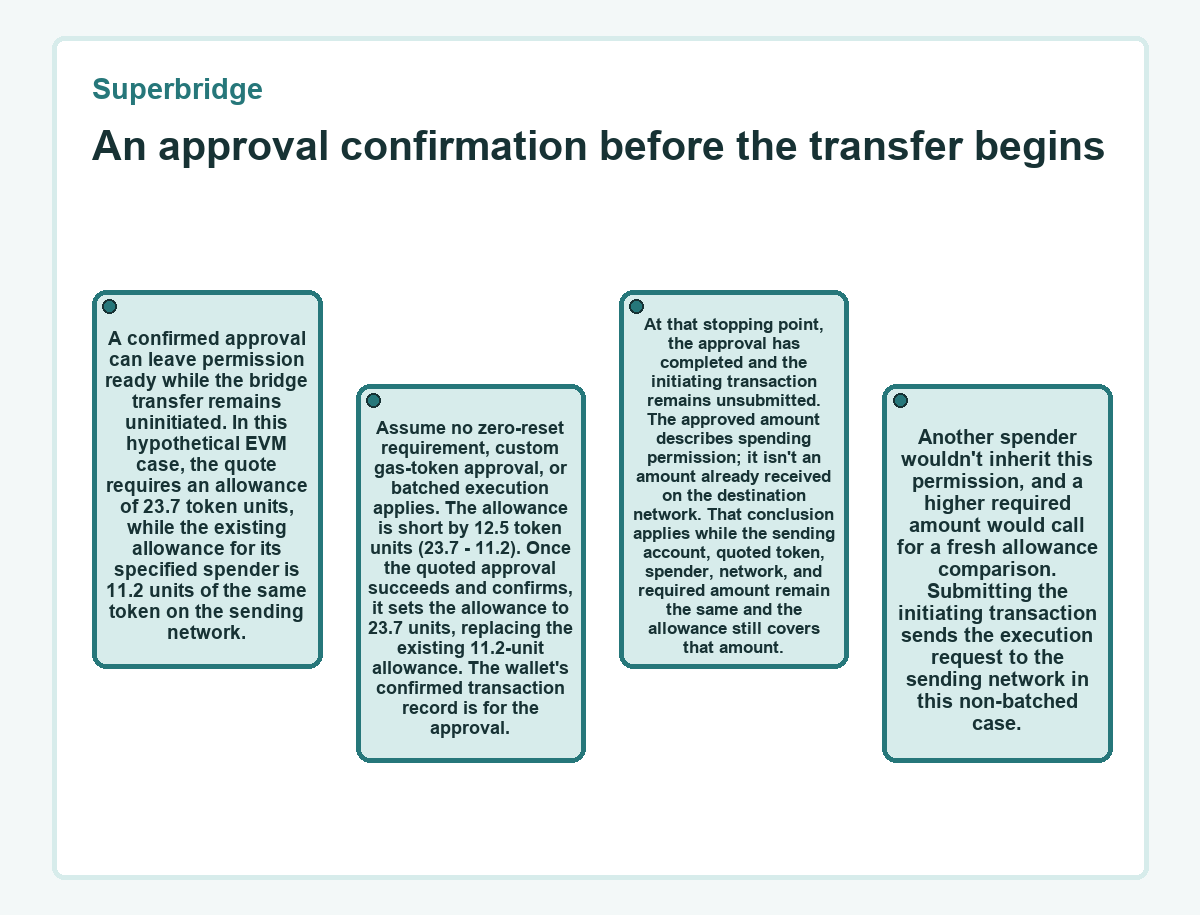
That conclusion applies while the sending account, quoted token, spender, network, and required amount remain the same and the allowance still covers that amount. Another spender wouldn't inherit this permission, and a higher required amount would call for a fresh allowance comparison. Submitting the initiating transaction sends the execution request to the sending network in this non-batched case.
Network charges and the quoted receive amount
Separately submitted approvals incur network charges, alongside charges for the transfer's initiating transaction and any later required transactions. Quote fees describe the planned transfer, while the approval amount describes how much a contract may spend. The expected receive amount identifies the quoted output, so it shouldn't be interpreted as an approval limit or confirmed delivery. Native withdrawals can require multiple transactions, making later network charges relevant before the first on-chain action. Network conditions and the selected route affect costs; a quoted fee isn't a fixed price for every transfer.
A token balance doesn't establish sufficient gas funding on the network where a separately submitted transaction executes.
Token-specific resets and destination gas
Some tokens, including USDT, require an existing non-zero allowance to return to zero before a new approval changes its value.
When
revokeTokenApproval
is present, the current allowance must be revoked before
tokenApproval
can execute.
That dependency changes the first action in the approval sequence. With separate transactions, the reset must take effect before the replacement approval can establish the new allowance. An existing non-zero allowance therefore doesn't always reduce the transaction count.
When the destination rollup uses a custom gas token, the route may include
gasTokenApproval
so it can send that token alongside the bridged asset to cover the gas cost of executing the destination transaction. This permission covers the gas token, which may differ from the token being bridged. Approving the input token doesn't automatically approve spending that other asset. Only the selected route's actual requirements establish whether this extra authorization applies.
Gasless routes use a different submission method: the user signs a message for relayed execution. This support applies to eligible routes, so a first transfer shouldn't assume every quote offers message-based execution. A signed message still authorizes an action. The route's subsequent activity establishes execution progress.
How can you tell the first transfer has finished?
The first transfer is complete when all its required activity steps are done, beyond any preceding approval. A transaction step marked
done
has reached on-chain confirmation, while a completed wait has finished its required delay. The full route can contain additional actions or waits after initiation. Activity reports their progress, so an approval confirmation or the first transfer transaction alone doesn't establish completion. The quote states the intended output token and expected receive amount. The matching destination transfer record identifies the recipient and amount actually credited, giving different evidence from the amount the quote predicted.
Popular questions about Superbridge
Does a first Superbridge transfer require unlimited token approval?
The Superbridge API specifies the minimum required approval amount and doesn't request an unlimited maximum. That rule describes the amount the API requests for the selected route. An existing allowance may already cover the requirement, so a first visit to the interface doesn't automatically require a new approval.
Which fields identify an approval in a Superbridge API quote?
An ERC-20 approval object identifies the token with tokenAddress, its spender with contractAddress, and the required allowance with amount. Its tx field contains a pre-built approval transaction. The spender is the contract whose allowance an integration checks; the destination recipient isn't a substitute for that permission target.
Are separate approvals required for a first transfer from Solana?
The Superbridge API doesn't require separate EVM-style approval steps for Solana transactions. Its token approval objects apply only to EVM routes. Solana uses a different transaction format and still requires signing for directly submitted transactions; the absence of an ERC-20 approval step doesn't remove that authorization requirement.
Can a compatible wallet batch the approval and initiating transaction?
Wallets with transaction batching support can combine required approvals and the initiating transaction into one execution. Supported examples include Safe multisig wallets and externally owned accounts using EIP-7702 delegation. The calls retain their dependency order inside the batch. Connecting an account alone doesn't establish that batching is available.
How does an integration submit a signed message for a first gasless transfer?
An integration submits the user's signed message for relay through the Submit Gasless endpoint. The request needs routeId, signature, metadata, and a chain identifier. Use one of chainUid, chainId, or chainKey, and preserve the opaque metadata returned with the route. This applies to routes offering message-based execution; a signature alone isn't evidence of a completed transfer.
Updated -